What proof to ask an AI builder for before you pay
Five kinds of evidence, from weakest to strongest, and what each tells you. How to check a demo, a case study and a reference in under an hour.
3 min read Reviewed 22 September 2026 · AgeBridge Editorial

Before paying an AI builder, ask for evidence you can check yourself in under an hour: a live demo of a real workflow, with the exception path shown; a case study with a measured number, its period and its method; and one client you can call who will say what happened after hand-over. Screenshots and recordings show that something exists and runs; only measured results and references tell you it worked for someone. Claims, stock images and certificates tell you nothing you can act on.
Why proof and not a pitch?
Because a pitch is the easiest thing to produce and the hardest to check. AI work in particular is easy to describe convincingly. What you're buying is the builder's habit of defining, testing, handling failures and handing over, and none of that shows in a pitch. It shows in evidence, and the strongest evidence is the kind the builder can't produce alone.
- Claims: 'I build AI automations.' Tells you nothing.
- Screenshots: A real workflow exists; you can't tell if it runs
- Recordings and live demos: It runs; you can't tell what it did for anyone
- Measured case studies: A number, a period, a method, a client's sentence
- References you can call: A named client who'll say what happened after hand-over
How to check a demo
Ask them to open it live, not to play a video. Watch for three things:
- It's real. Real tool, real accounts, real-looking data. A slide is not a demo.
- It handles a wrong input. Ask them to send something that doesn't fit the rules and show where it goes. There should be a path to a person and a log.
- They can explain a failure. "What went wrong on this one and what did you change?" A real build has a story; a fabricated one doesn't.
Five minutes is enough.
How to check a case study
A case study you can trust has four parts: what the client's situation was, what was built, a number with its period and method ("median reply time, two weeks before and after, from CRM timestamps"), and a sentence from the client, named or with a stated reason for anonymity. Missing the number or the method, it's a story. Round numbers with no period ("saved 80%") are marketing.
How to check a reference
One call, ten minutes, three questions: "What did they build, and does it still run?" "What happened when something went wrong?" "Would you hire them again, and for what?" The third answer is the one that matters. A reference who can only say "they were nice" hasn't watched the work run.
Written proof for the pilot itself
Before paying for the pilot, ask for: a one-page scope with "done" and exclusions, a list of the test cases they'll run on your data, and the hand-over page format. Builders who work this way produce these in an hour; those who don't will find the request unusual, which is information.
Red flags
- Can't open a demo live.
- Every result is a round percentage with no period or method.
- No client can be named, and no reason is given.
- The scope is verbal.
- Pressure to sign for a system before a pilot.
- Results that seem too good to be true; ask how they were measured.
Your rights, briefly
A written scope and price is a contract like any other; Israel's consumer protection and contract law apply to services too. Keep the brief and the messages. Most disputes are resolved by pointing at the sentence that defined "done", which is why you insist on it being written.
Best fit and not a good fit
Best fit: owners choosing between two or three builders for a first project. Not a good fit: as a reason to demand a free build; the fair test of a builder is a small paid pilot with a written scope.
What to do next
Pick your shortlist and run each through demo, case study and reference this week. On the marketplace, profiles show which evidence is attached to each project, so you can shortlist by proof before the first call.
Questions people ask
Is a portfolio on a platform enough?
It's a starting point. Look at what's on it: screenshots and recordings of real builds, measured results, named clients. A profile with claims and stock images is a claim with a nicer layout.
What if the builder is new and has no clients?
New builders can still show recordings of real builds, test sets, and hand-over documents from practice projects. Price the pilot accordingly, ask for a clear 'done', and check the demo carefully. Everyone's first client took that risk knowingly.
Should I ask for a free trial build?
No. Free work selects for builders with no other clients and produces a demo that isn't tested on your data. A small paid pilot with a written scope is the fair version of the same idea.
Sources
- Israel Consumer Protection and Fair Trade Authority · gov.il · 2026-06-01
Editorial guidance, not advice. Estimates are labelled and dated; nothing here is AgeBridge marketplace data unless it says so.
Find builders who have done this
Profiles with real projects and evidence, not claims.
Browse the marketplaceRelated guides

How to write a case study a business owner will actually read
A one-page structure for AI-builder case studies: the problem in the owner's words, what you built in plain language, what changed, and proof a buyer can check.
4 min read · 22 September 2026
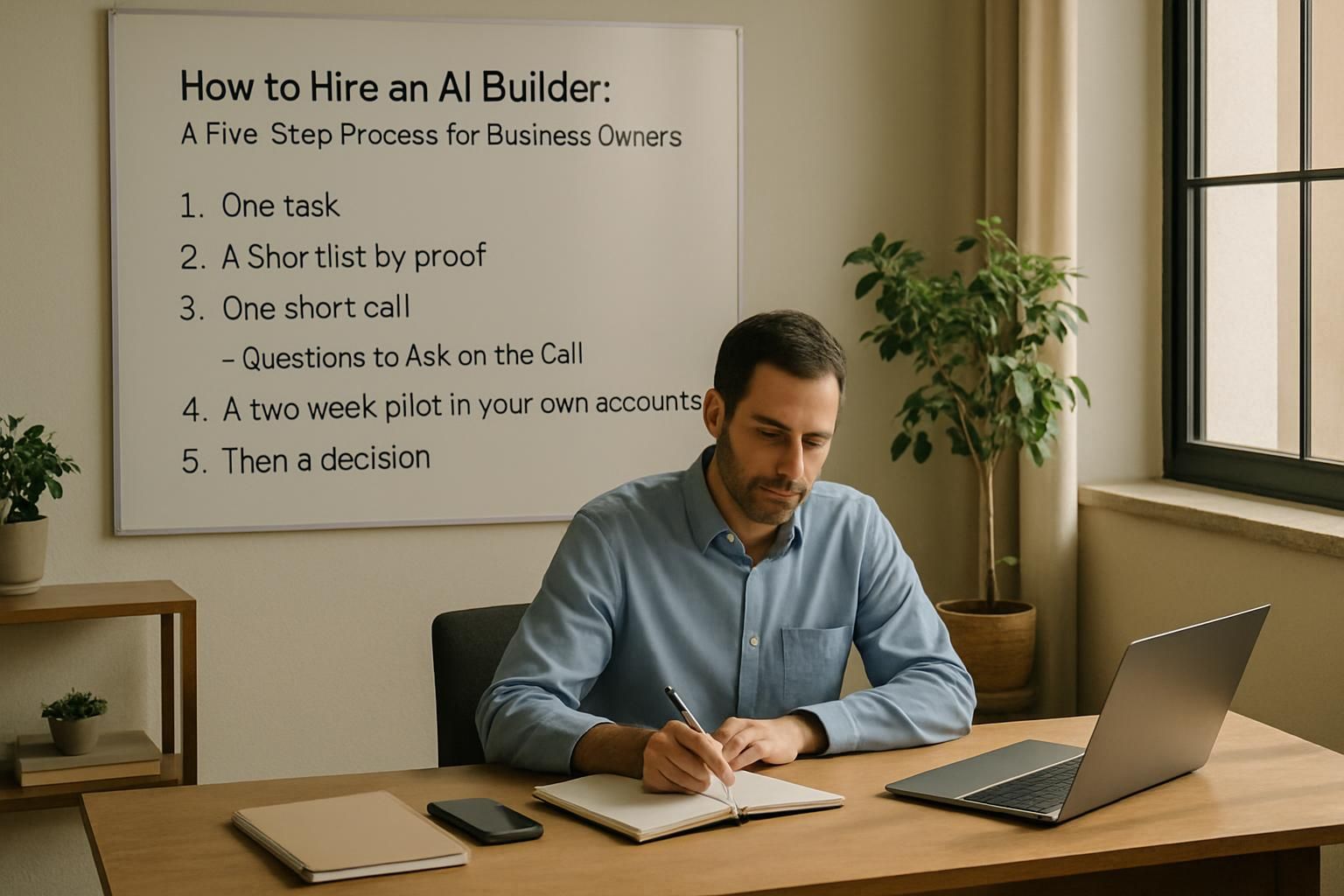
How to hire an AI builder: a five-step process for business owners
Five steps: one task, a shortlist by proof, one short call, a two-week pilot in your own accounts, then a decision. Plus the questions to ask on the call.
3 min read · 22 September 2026
Proof over claims: the evidence that convinces a buyer
Buyers rank evidence: a demo beats a screenshot, a screenshot beats a description, a description beats a skill badge. The proof ladder and how to climb it.
3 min read · 22 September 2026