How to hire an AI builder: a five-step process for business owners
Five steps: one task, a shortlist by proof, one short call, a two-week pilot in your own accounts, then a decision. Plus the questions to ask on the call.
3 min read Reviewed 22 September 2026 · AgeBridge Editorial
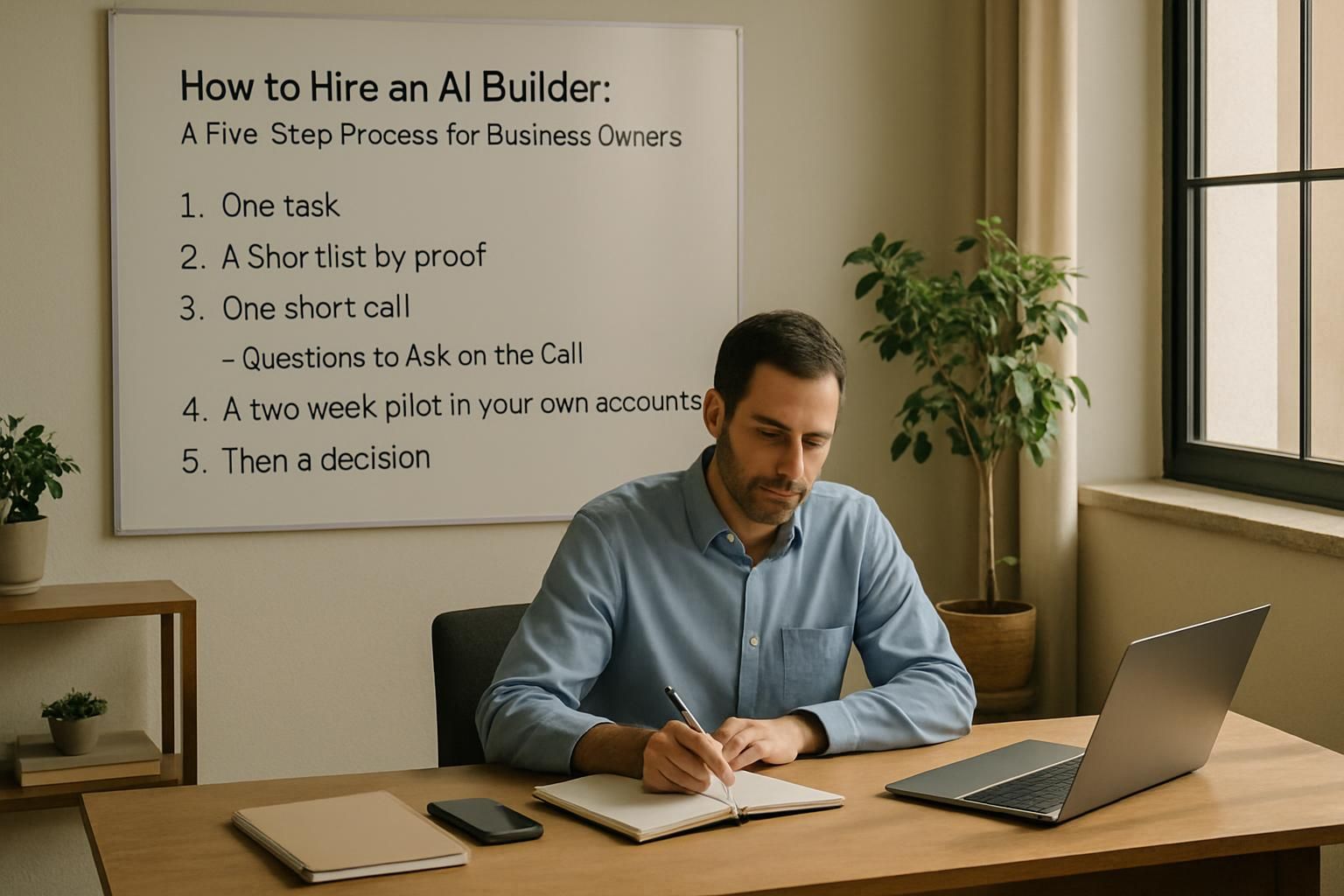
Hire an AI builder in five steps: write the one task and the number that would show it worked; shortlist two or three builders who show proof of a similar build; hold one thirty-minute call each with the questions below; run a two-week pilot in your own accounts with "done" written down; then decide between continuing, a support plan, or stopping with what you have. The proof and the pilot do most of the work; the call is for finding out how the builder handles what goes wrong.
Step 1: define one task
Before you look at anyone, write one sentence: "Reply to website leads within a minute, log them in the CRM, and tell me when one is urgent." Add the number: "median reply time, now nine hours." A builder can quote and pilot that. "Help us with AI" gets you a proposal for whatever the builder likes building.
- Define one task: One sentence, one number, this week
- Shortlist by proof: Two or three builders who show a similar build
- One call each: Thirty minutes, the questions below
- Two-week pilot: In your accounts, with 'done' written down
- Decide: Continue, support plan, or stop with what you have
Step 2: shortlist by proof
On the marketplace or anywhere else, look for builders who show a finished build close to your task: a screenshot of the actual workflow, a recording of it running, a measured before-and-after, and a client who agreed to be named. Ignore claims without evidence. Two or three candidates who pass are enough. Location matters less than whether they've worked with your channel (WhatsApp, in most Israeli small businesses) and your tools.
Step 3: the thirty-minute call
Ask, and listen for the shape of the answer:
- "Show me something similar you've built." (They open it live, or they don't.)
- "What went wrong on it, and what did you change?" (Every real project has an answer.)
- "What happens when a message doesn't fit the rules?" (There should be a path to a person.)
- "Where does my data go, and who can see it?" (A clear answer with minimisation and access per person; the Privacy Protection Authority's guidance is the reference.)
- "What's 'done' for the pilot, and what's excluded?" (Written, before you pay.)
- "What does it cost to run per month, and what does support look like?" (All the running costs, not just the build.)
- "Who owns the accounts and the workflows?" (You do, in your own tools.)
Answers that should worry you: a demo they can't open, "it never fails", a vague answer about data, a promise to automate "everything", and a price with no scope.
Step 4: the two-week pilot
One task, fixed price, in your accounts, tested on your real data, with a hand-over page your team can follow. Give the builder admin access and a decision-maker who answers within a day; slow answers are the main reason pilots overrun. At the end you should see the number, the logs, and the exceptions that went to a person.
Step 5: decide
Three good outcomes: continue to a second adjacent automation, take a support plan and let it run, or stop with a working pilot and a write-up. One bad outcome: nothing measured, nothing handed over. The pilot's structure is what prevents that, which is why it's worth insisting on before the first shekel.
Best fit and not a good fit
Best fit: owners hiring for a first or second automation. Not a good fit: businesses needing a full system or a team on day one; hire an agency or a lead builder with a track record of larger projects, and still start with a pilot.
What to do next
Write the sentence and the number. Then open the marketplace, filter for builders with a similar project and visible proof, and book the first call.
Questions people ask
Freelancer, agency or someone in-house?
For a first automation, an independent builder with proof in your kind of business is usually the right size. An agency suits several projects at once; in-house suits a business that will automate continuously and can keep someone busy.
How many builders should I talk to?
Two or three. One gives you no comparison; five costs you a week of calls and the differences blur. Compare scope and proof, not just price.
What if the pilot fails?
You've spent two weeks and a small budget, and you know something true about the task. Keep the brief, the test cases and the write-up; the next attempt starts further along.
Sources
- Israel Privacy Protection Authority · gov.il · 2026-06-01
Editorial guidance, not advice. Estimates are labelled and dated; nothing here is AgeBridge marketplace data unless it says so.
Find builders who have done this
Profiles with real projects and evidence, not claims.
Browse the marketplaceRelated guides

How much does AI automation cost in Israel? Ranges, assumptions, dated
Editorial cost ranges in shekels for common small-business automations, what moves a quote up or down, and the running costs owners forget.
3 min read · 22 September 2026

What companies actually buy from AI builders in 2026
Businesses buy outcomes, not models: fewer missed leads, faster answers, less manual data entry. What sells, what doesn't, and how to describe your work.
4 min read · 22 September 2026

What proof to ask an AI builder for before you pay
Five kinds of evidence, from weakest to strongest, and what each tells you. How to check a demo, a case study and a reference in under an hour.
3 min read · 22 September 2026