Estimating ROI before you build an AI automation
A one-page ROI estimate in twenty minutes: hours saved, what they cost, revenue touched, minus build and running costs. With a worked example.
3 min read Reviewed 22 September 2026 · AgeBridge Editorial
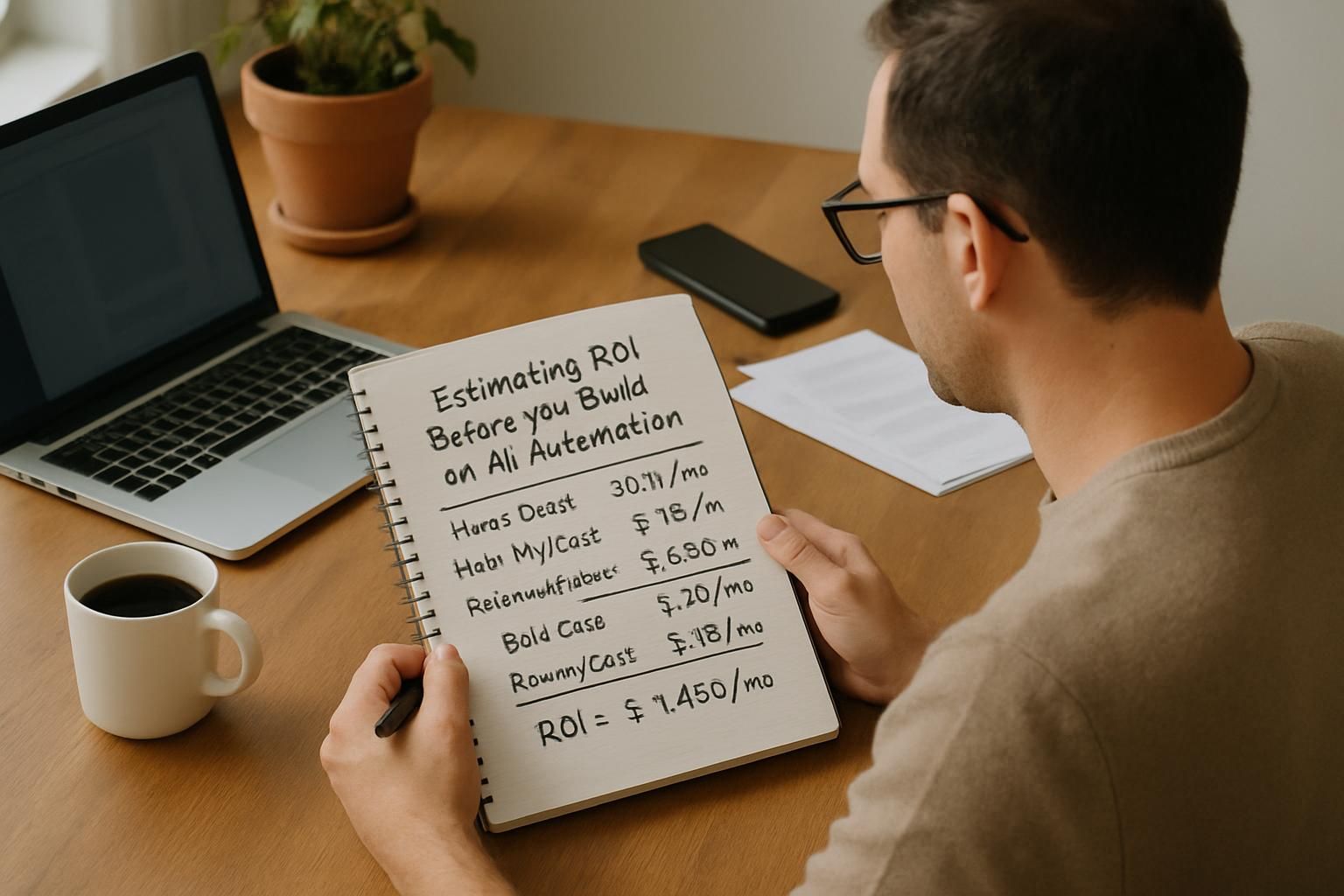
Estimate the return on an AI automation in twenty minutes on one page: count the hours the task takes per month, multiply by what an hour costs you, add only the revenue you can attribute to the task conservatively, then subtract the build quote and the monthly running costs. Divide to get months to pay back. Under six months is a strong case for a two-week pilot; six to twelve is fine; over twelve means the scope is wrong, not necessarily the idea. The pilot then replaces the estimate with a measured number.
Why estimate at all?
Because "AI will save us time" isn't a decision. A one-page estimate tells you which task to pilot first, what a reasonable quote looks like, and what number the pilot must hit. It also protects you from the two common mistakes: paying for an automation that saves two hours a month, and refusing one that would pay back in six weeks.
- Hours the task takes per month: Count for one week, multiply by four
- × what an hour costs you: Salary plus overhead, or your own hourly value
- + revenue the task touches: Only what you can attribute, conservatively
- − build cost − monthly running cost: From the quotes and vendor pricing
- = months to pay back: Under 6: strong. 6–12: fine. Over 12: rethink scope
Step 1: hours per month
Pick one task, as in the "what to automate first" guide. Have the person who does it count for one week: minutes per occurrence, occurrences per day. Multiply by four. Include the hidden parts: looking things up, chasing, fixing mistakes. Don't include time the automation won't touch, such as the judgement calls a person will still make.
Step 2: what an hour costs
For an employee, salary plus employer costs, divided by working hours; the Central Bureau of Statistics publishes wage data if you need a benchmark. For your own hours, use what an hour of your time is worth when spent on the business instead. Be honest in both directions; overstating makes every project look good.
Step 3: revenue the task touches
Only for tasks that directly touch sales or attendance: lead replies, quote follow-ups, reminders. Estimate conservatively: "we lose about five leads a month to slow replies; a third would have booked; an average booking is X." If you can't fill a sentence like that, leave revenue at zero and decide on hours alone.
Step 4: costs
Build cost from two or three quotes, as in the cost guide. Running costs from the vendors' pricing pages and the builder's volume estimate: the workflow platform, the messaging provider, AI usage, and a support plan if you take one. Put the support plan in; a build with nobody watching it is not the thing you're valuing.
Step 5: months to pay back
Monthly benefit is hours × cost plus attributed revenue, minus running costs. Payback is build cost divided by monthly benefit. Write it down with the date and the assumptions; you'll compare it against the pilot's measurement.
A worked example (illustrative, not a client)
| Line | Value |
|---|---|
| Hours per month on lead replies and logging | 30 |
| Cost per hour (salary plus overhead) | ₪70 |
| Hours value per month | ₪2,100 |
| Attributed revenue per month (conservative) | ₪1,500 |
| Running costs per month | ₪400 |
| Monthly benefit | ₪3,200 |
| Build quote | ₪5,500 |
| Payback | under 2 months |
Change the hours to eight and the revenue to zero, and payback stretches past two years; the same automation, a different business. The numbers are made up to show the arithmetic; yours will differ.
What the estimate can't tell you
Whether it will actually work on your data, whether your team will use it, and whether the exceptions are rare or constant. Those are what the pilot answers. Treat the estimate as the reason to run the pilot, and the pilot's number as the reason to continue.
Best fit and not a good fit
Best fit: owners choosing between two or three tasks, or deciding whether a quote is worth it. Not a good fit: projects whose value is mostly risk reduction or customer experience; estimate those on hours, and accept that part of the return is unmeasured.
What to do next
Fill the five lines for your top task. If payback is under a year, take the page to two or three builders on the marketplace and ask for a two-week pilot that measures the number you used.
Questions people ask
What if I can't put a number on revenue?
Leave it out. An estimate on hours alone is honest and often enough. If the automation only makes sense with a revenue guess, the pilot should measure that number before you commit to more.
How accurate does this need to be?
Within a factor of two. You're deciding whether to run a two-week pilot, not signing a year. The pilot replaces the estimate with a measurement.
Should the builder do this for me?
Ask them to check it, not to write it. Your hours and your prices are the inputs, and the builder has an interest in the answer. A builder who pushes back on your optimistic numbers is one to keep.
Does AgeBridge value projects?
No. Inside the platform, AgeBridge never suggests what a project is worth or what a builder should charge. This guide is public editorial to help you do your own estimate.
Sources
- Israel Central Bureau of Statistics: wages · CBS · 2026-06-01
- Make: pricing and plans · Make · 2026-06-01
Editorial guidance, not advice. Estimates are labelled and dated; nothing here is AgeBridge marketplace data unless it says so.
Find builders who have done this
Profiles with real projects and evidence, not claims.
Browse the marketplaceRelated guides

How long does an AI automation project take? Realistic timelines
Editorial timelines for common small-business automations, what makes them slip, and which parts of the calendar belong to you, not the builder.
3 min read · 22 September 2026

How much does AI automation cost in Israel? Ranges, assumptions, dated
Editorial cost ranges in shekels for common small-business automations, what moves a quote up or down, and the running costs owners forget.
3 min read · 22 September 2026

What should a small business automate with AI first?
A decision method for owners: score your repetitive tasks by volume, pain and clarity, start with one that touches customers, and run it as a two-week pilot.
4 min read · 22 September 2026