Terms for small AI projects: what to cover (not legal advice)
One-page terms before the first invoice: scope, payment, access, data, ownership, support and what happens when things change. A checklist, not a contract.
3 min read Reviewed 22 September 2026 · AgeBridge Editorial
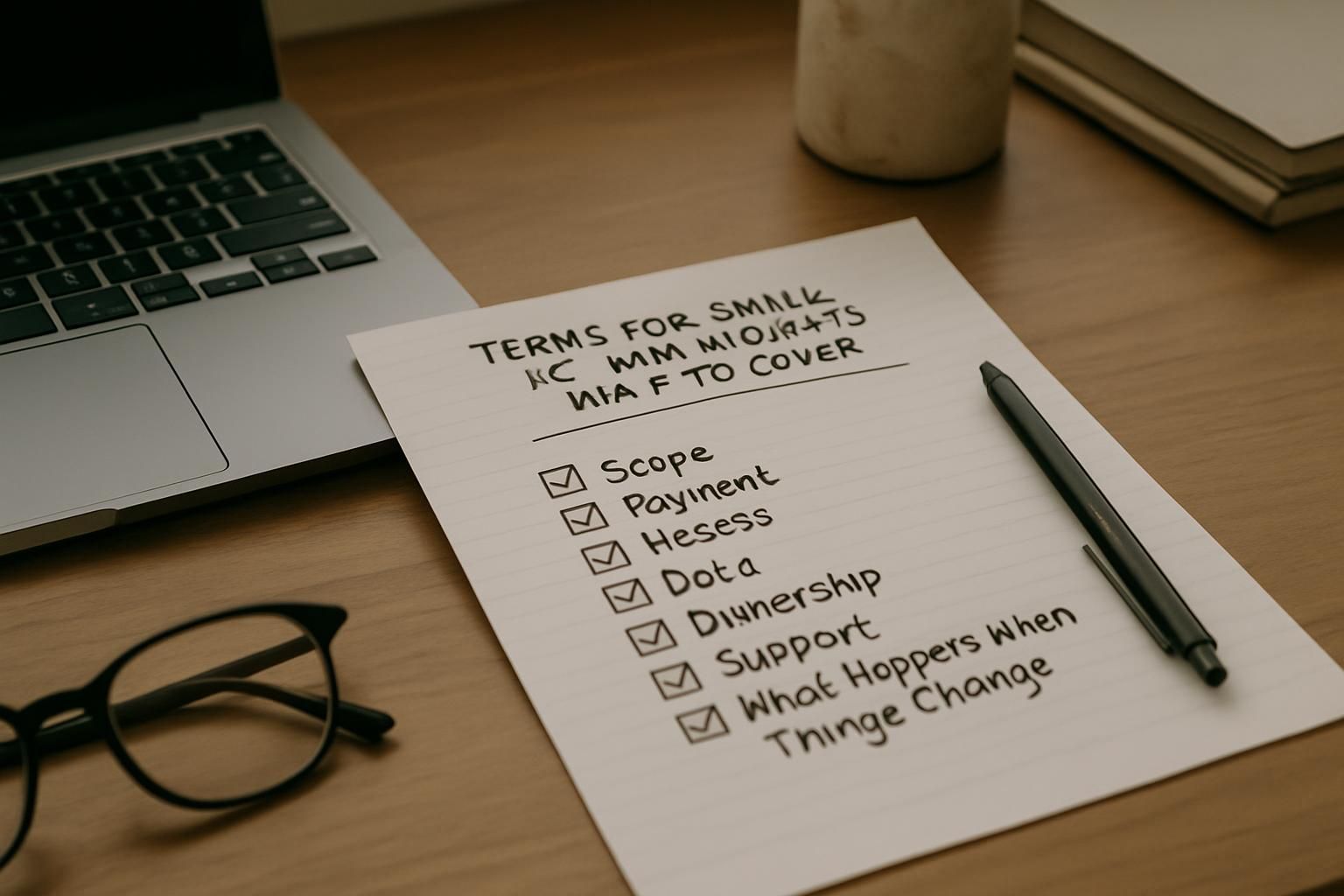
Terms for a small AI project fit on one page and cover seven things: the scope (the brief, attached, with exclusions), payment (amounts, schedule, what triggers each), what the client provides and by when, how data is handled, whose accounts host the automation and who owns what afterwards, what support is included and for how long, and how changes, delays and cancellation work. This is a checklist for what your terms must say, not a contract; have a lawyer turn it into your standard document once and reuse it for every project.
Why one page, and why before the first invoice?
Because the disputes on small projects are predictable: "I thought that was included", "we'll pay when it's fully working", "we need it on our server after all", "can you keep supporting it for free?". Each one is a paragraph. Written before the pilot, they are agreements; discussed after, they are arguments.
- Scope: The brief, attached; what's excluded
- Payment: Amounts, schedule, what triggers each
- Access and cooperation: What the client provides, by when
- Data: What you touch, where it goes, retention
- Ownership and accounts: Whose accounts, who owns what after
- Support: What's included after hand-over, for how long
- Changes and ending: Add-ons, delays, cancellation
1. Scope
Attach the one-page brief and refer to it. Repeat the exclusions in the terms. State what "done" means in the same words as the brief: "runs on real inputs for five working days without manual fixes". Ambiguity here costs more than anywhere else.
2. Payment
Amounts, currency, and what triggers each payment: a share on approval of the brief, the rest on "done" as defined. Payment terms in days. What happens if the client delays access (the clock pauses, or the schedule shifts). Whether the pilot fee is credited against a full build. Invoice details per the Tax Authority's rules for your business status.
3. Access and cooperation
What the client provides and by when: accounts, credentials, sample data, a decision-maker's availability. Say plainly that the timeline starts when access is granted. This one sentence prevents the three-week pilot.
4. Data
Reference the data checklist: what personal data the automation touches, which vendors process it, retention, and what happens to your access at the end. State that the client remains responsible for their customer data and their legal obligations, and that you'll handle it as agreed in writing.
5. Ownership and accounts
Prefer the client's accounts for every tool. State that the workflow built for them is theirs to use, that your generic templates and know-how remain yours, and that your access ends at hand-over unless a support plan says otherwise. Say who pays the tool subscriptions.
6. Support
What's included after hand-over and for how long: usually a short warranty period for defects in the agreed scope, then the support plan if they take one. Not included: changes, new features, failures caused by changes the client made.
7. Changes and ending
Changes are written add-ons with their own price and timing. Either side can end the project with notice; work done is paid for; you hand over what exists. Without this paragraph, ending badly is the only way to end.
Keep the tone readable
Terms an owner can read in five minutes get signed; terms that look like a lease get "let me check with someone" and silence. Plain language, short sections, the same words as the brief.
Note This guide is editorial, not legal advice. Laws on contracts, invoicing and data differ; a lawyer should review your standard terms once, and anything sensitive every time.
Best fit and not a good fit
Best fit: builders about to invoice their first or fifth client who have no written terms yet. Not a good fit: large or regulated projects; those need a lawyer from the start, not a checklist.
What to do this week
Draft your seven sections on one page from your last project's brief. Book an hour with a lawyer to turn it into your standard terms. Send it with your next pilot offer.
Questions people ask
Do I really need written terms for a two-week pilot?
Yes, one page. Most disputes on small projects are about payment timing and scope, and both are prevented by two paragraphs written before the work starts.
Should the client's accounts or mine host the automation?
The client's, wherever possible. It keeps ownership clear, avoids you holding their data, and makes hand-over trivial. Say so in the terms.
Is this a contract template?
No. It's a checklist of what your terms should cover. Have a lawyer turn it into your standard document once; then reuse it.
Sources
- Israel Tax Authority · gov.il · 2026-06-01
Editorial guidance, not advice. Estimates are labelled and dated; nothing here is AgeBridge marketplace data unless it says so.
Put this into practice on your AgeBridge profile
A free profile with real projects is what businesses look at first.
Build my profileRelated guides

Handling client data safely: a builder's checklist for Israel
What to collect, where it may go, who can see it and how long it's kept, plus the Israeli privacy basics to know before touching a client's customer data.
4 min read · 22 September 2026

How to price AI-automation work: fixed, retainer or hourly
A method, not a number: when fixed price, retainer or hourly fits, how to build a price from scope and risk, and the mistakes that cost new builders most.
4 min read · 22 September 2026

Turning a vague request into a clear brief (with the template)
'Something with AI' becomes a one-page brief: task, trigger, systems, exception path, measurement and what's out. The questions to ask and the template.
3 min read · 22 September 2026