The AI builder's skills roadmap for 2026: what to learn first
Learn in the order clients pay for: one workflow tool, WhatsApp, one CRM, then retrieval, approvals and testing. What to skip and what counts as proof.
3 min read Reviewed 22 September 2026 · AgeBridge Editorial
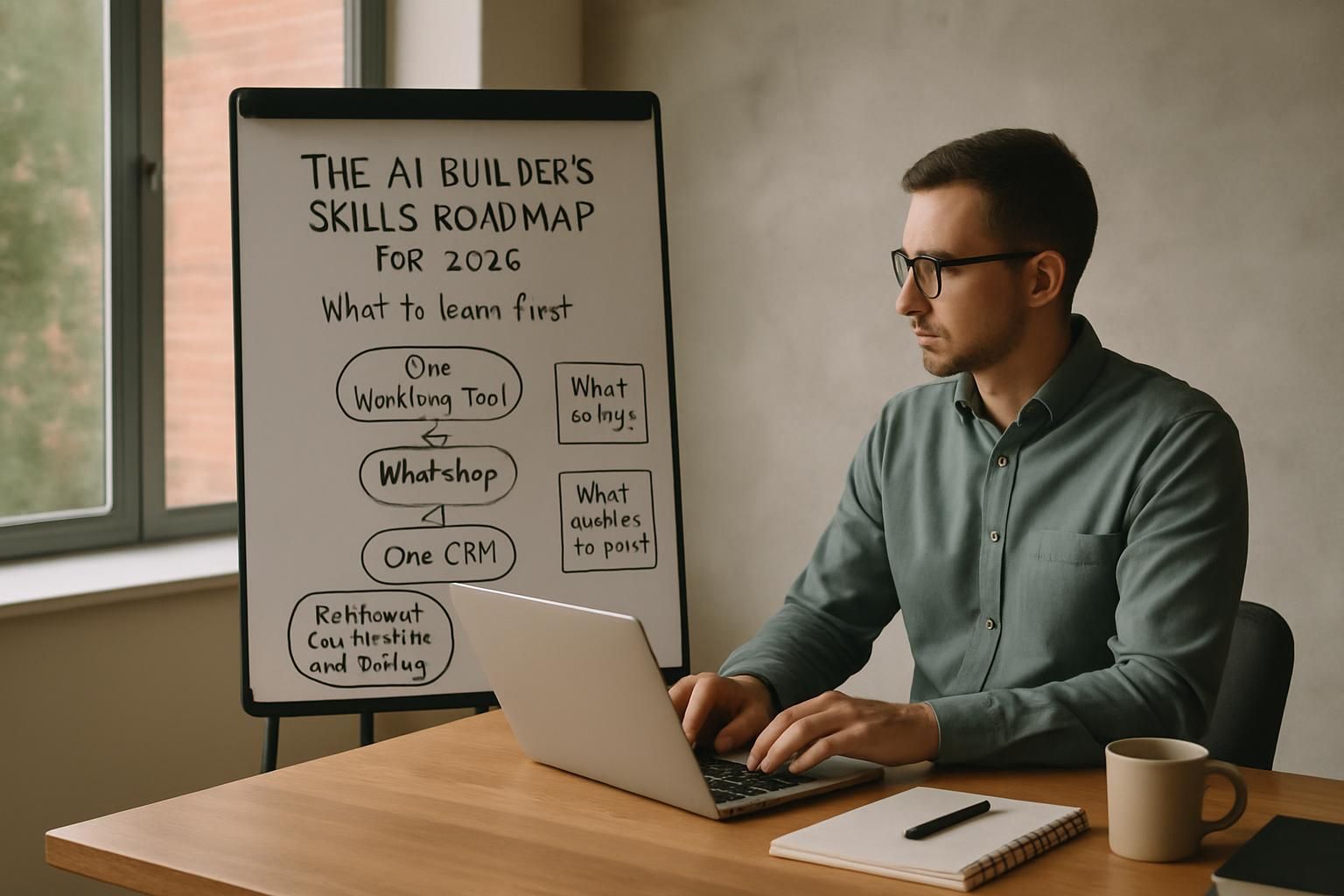
Learn the skills in the order clients pay for them: first one workflow tool, the WhatsApp Business Platform, one CRM and spreadsheets; then prompts that return structured data, document extraction, exception paths and logging; then the trust layer of retrieval with citations, human approvals, testing and data hygiene; and throughout, the practice skills of scoping, pricing, hand-over and the monthly note. Twelve weeks of weekly builds cover the first three layers. Skip model-by-model tutorials and anything you can't turn into a finished build on your profile.
Why this order?
Because it mirrors what a small business buys first: a lead reply, a reminder, a document sorted. Those need the foundation layer and nothing else. The core layer makes them reliable; the trust layer makes them safe enough to run unattended; the practice layer is what turns a build into a business. Learning retrieval before you can write a WhatsApp template is learning the roof before the walls.
- Foundation (weeks 1–4): One workflow tool, WhatsApp Business Platform, one CRM, sheets
- Core (weeks 5–8): Prompts that return structure, extraction, exception paths, logging
- Trust (weeks 9–12): Retrieval with citations, approvals, testing, data hygiene
- Practice (ongoing): Scoping, pricing, hand-over, the monthly note
Foundation (weeks 1–4)
- One workflow tool, deeply. Make or n8n: triggers, routers, error handling, scheduling, webhooks. Not both; depth first.
- WhatsApp Business Platform. The 24-hour window, templates, buttons, the rules in Israel. It's the channel most of your clients live in.
- One CRM. Objects, stages, search-before-create, webhooks. HubSpot, monday.com or Pipedrive; whichever your niche uses.
- Sheets as a database. Half of small-business data lives there; know how to read, write and de-duplicate it.
Builds that prove it: lead reply + CRM entry; appointment reminder; form-to-sheet with de-duplication.
Core (weeks 5–8)
- Structured output. Making a model return fields in a fixed shape, with confidence, and saying "unknown" instead of guessing.
- Extraction. Invoices, forms, messages into fields; validation rules.
- Exception paths. The step where unusual inputs go to a person, designed before the happy path is polished.
- Logging and alerts. Every run recorded; every failure reaches your phone.
Builds that prove it: invoice extraction to a sheet; quote follow-up with a routed exception; a failure-alert flow.
Trust (weeks 9–12)
- Retrieval with citations. Answering only from a business's documents and showing where.
- Approvals. One-tap approve-before-send in the channel the approver uses.
- Testing. A forty-case set with expected outcomes, including must-route and adversarial cases.
- Data hygiene and privacy. Minimisation, access per person, retention, the Israeli basics.
Builds that prove it: a RAG assistant on a help centre; an approval flow on WhatsApp; a documented test set attached to a project.
Practice (ongoing)
Discovery calls, briefs, pricing from hours and risk, hand-over pages, the monthly note, saying no. None of it is technical, all of it is what clients remember. The guides on this blog cover each one; the guided builds on AgeBridge are structured around them.
What to skip in 2026
- Model-of-the-month tutorials; learn structure and testing instead.
- Building your own agent framework; use the workflow tool's.
- Certificates as a goal; builds as a goal.
- "Full-stack AI" before one niche pays you.
- Dashboards before automations.
How each skill shows up as proof
| Skill | Proof on your profile |
|---|---|
| Workflow tool | Screenshot of a real scenario with an exception route |
| Recording of a reply arriving on a business number | |
| Extraction | Before/after of a sheet filled from documents |
| Retrieval | Answer with a visible citation |
| Testing | The sign-off table attached as evidence |
| Practice | A case study with a measured number and a client sentence |
Best fit and not a good fit
Best fit: builders in their first year who want a sequence instead of a list of tools. Not a good fit: experienced developers; for them the roadmap is the practice layer only, which is also the one most skip.
What to do this week
Pick the layer you're in. Choose the build that proves the next skill, from the weekly-builds guide or a guided build, and finish it by Friday.
Questions people ask
Do I need to learn to code?
Enough to write a small function inside a workflow step and read an API reference. Full software engineering is a different career; most small-business automations don't need it.
Which AI model should I learn?
Learn to make any model return structured output reliably and to test it. Models change every few months; the habit of structure and testing doesn't.
How do I know a skill is learned?
When it appears on your profile as a finished build with a screenshot and a recording. A course certificate says you watched; a build says you can.
Sources
- Make: Getting started · Make · 2026-06-01
- OpenAI platform documentation · OpenAI · 2026-06-01
Editorial guidance, not advice. Estimates are labelled and dated; nothing here is AgeBridge marketplace data unless it says so.
Build it step by step with a guided build
Real projects, one stage at a time, with proof at the end.
See guided buildsRelated guides

How to turn an AgeBridge guided build into a paid service
A finished guided build is a rehearsed offer. Run it on realistic data, document it, name the business it fits, and sell it as a fixed-scope pilot.
3 min read · 22 September 2026
Make vs n8n vs Zapier vs custom code: when each one wins for a builder
A builder's decision guide: which tool to choose by client, complexity, data sensitivity and who maintains it, with the trade-offs that matter after launch.
4 min read · 22 September 2026

Building a reputation with weekly builds
One small, finished, documented build a week compounds into proof, skills and an audience faster than any course. The routine, what to build, how to show it.
3 min read · 22 September 2026