How long automations really take: effort ranges, labelled
Editorial effort ranges for common automations, what stretches them (access, messy data, approvals), and how to turn a range into a date a client can rely on.
3 min read Reviewed 22 September 2026 · AgeBridge Editorial
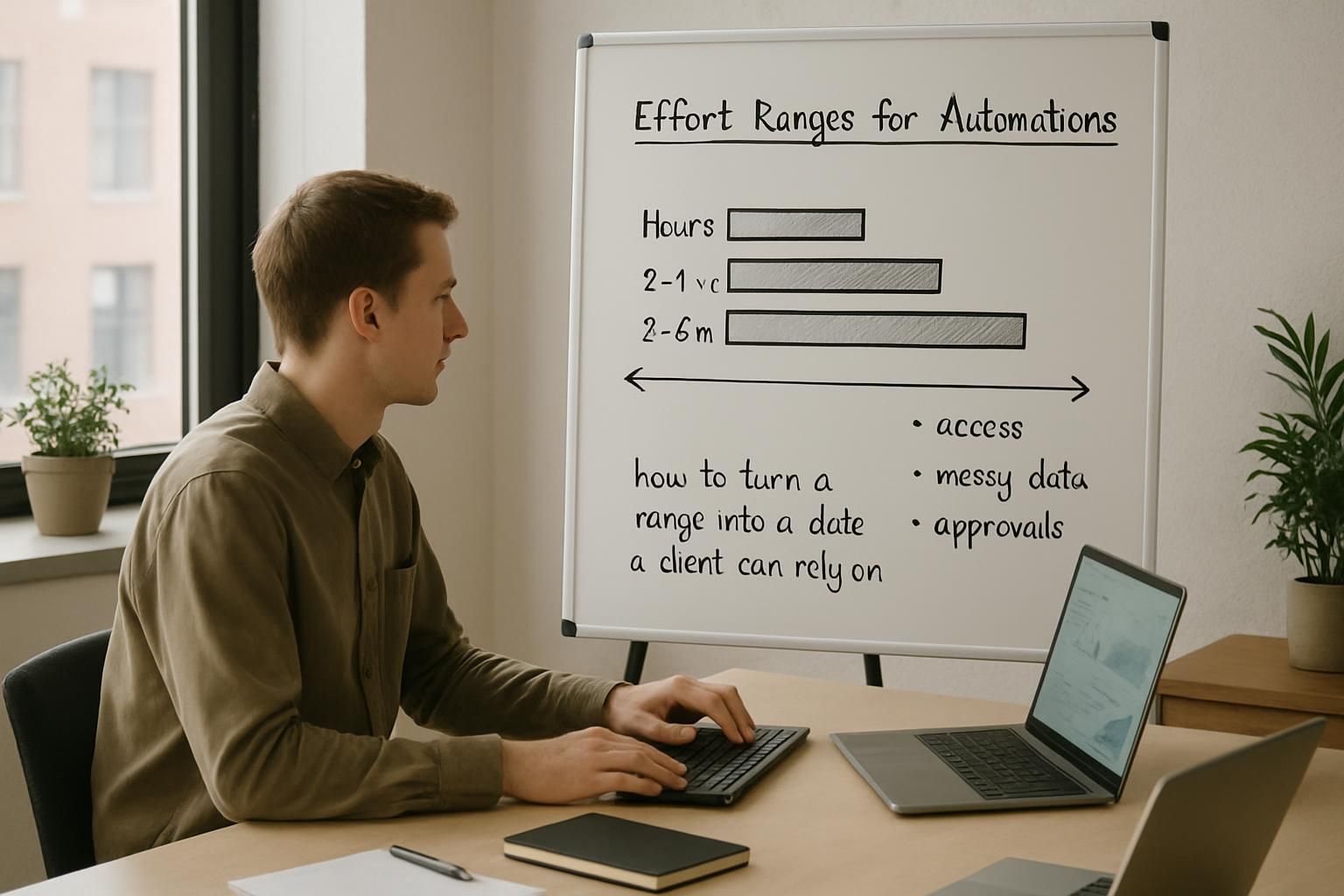
Common first automations take a builder who knows the tools between two and twelve working days of effort, depending on the type: a lead reply with a CRM entry sits at the short end, an invoice pipeline or a RAG assistant at the long end. What stretches any of them is not the building but waiting for access, cleaning messy data and designing approvals. The ranges below are editorial estimates with their assumptions stated; use them to quote a date that starts when you have the logins, and replace them with your own numbers after five projects.
What the ranges assume
The chart assumes a written brief, a business with existing systems (WhatsApp Business, a CRM or sheets, a calendar), a builder fluent in Make, n8n or code, and no waiting for the client. Every assumption that fails adds days. They are not AgeBridge marketplace data and they are not a promise; they are a starting point for your own log.
| Builder effort for common first automations (working days, editorial estimate) | days |
|---|---|
| Lead reply + CRM entry | 2–5 days |
| Appointment reminders | 2–4 days |
| Quote follow-up sequence | 3–6 days |
| Invoice extraction to sheet | 4–8 days |
| RAG support assistant | 6–12 days |
| Lead-qualification agent | 6–12 days |
Editorial estimate, Israel, September 2026, for a builder who knows the tools, a small business with existing systems, and a written brief. Excludes waiting for client access. Not AgeBridge marketplace data; ranges narrow with experience and widen with messy data.
Where the days actually go
| Phase | Share of effort (typical) | What makes it longer |
|---|---|---|
| Discovery and brief | 15–20% | Unclear owner, several decision-makers |
| Building | 30–40% | New tool for you, unusual integration |
| Testing on real data | 25–30% | Messy inputs, edge cases, Hebrew/English mixes |
| Hand-over and docs | 15–20% | No hand-over habit; skipping it costs more later |
New builders estimate the building phase and forget the other three; that's most of the gap between estimate and reality.
The three stretchers
Access. A pilot waiting a week for a WhatsApp Business account or a CRM admin login is a three-week pilot. Start the clock at access and say so in the terms.
Messy data. Duplicates, missing fields, contradictory documents. Budget a cleanup day for any project touching a CRM or a knowledge base, and tell the client why.
Approvals. Every human-in-the-loop step needs designing, building and testing with the approver. Worth it, but not free.
Turning a range into a date
- Take the range for the type. Pick the middle unless the brief says the data is clean (lower) or the systems are unfamiliar (upper).
- Add the stretchers you can see: unfamiliar tool, cleanup, approvals.
- Convert effort days to calendar days at your real availability (three effort days a week is common for a builder with other clients).
- Start the date at access, in writing.
- Say what happens if the client is slow: the date moves with them, not with you.
Short projects that are actually long
Anything described as "just connect X to Y" where X is a system nobody has admin access to; anything involving a new WhatsApp number (verification and template approval add days outside your control); anything where the owner "will think about the rules" during the build. Name these in the brief, and put a date on each one so the delay has an owner.
Best fit and not a good fit
Best fit: builders quoting their first projects, and anyone who has been burned by estimating the build alone. Not a good fit: as a benchmark to argue with a client; the honest use is "here's my estimate, here's what it assumes, here's the date".
What to do this week
Log the actual hours of your current project by phase. Compare to your estimate at the end. Adjust your personal ranges; they are the only ones that matter.
Questions people ask
Why is the range so wide?
Because three things vary per client: how clean the data is, how many systems are involved, and how fast they grant access and answer questions. The brief narrows all three.
Should I quote in days or in a date?
Estimate in days, promise a date, and start the clock at access. 'Two weeks from the day I have the logins' is a promise you can keep.
How do I get better at estimating?
Log actual hours per phase on every project and compare them to your estimate. After five projects your ranges are yours, not this article's.
Sources
- Make: Getting started · Make · 2026-06-01
- n8n documentation · n8n · 2026-06-01
Editorial guidance, not advice. Estimates are labelled and dated; nothing here is AgeBridge marketplace data unless it says so.
Put this into practice on your AgeBridge profile
A free profile with real projects is what businesses look at first.
Build my profileRelated guides

How to price AI-automation work: fixed, retainer or hourly
A method, not a number: when fixed price, retainer or hourly fits, how to build a price from scope and risk, and the mistakes that cost new builders most.
4 min read · 22 September 2026

How to run a two-week pilot that turns into a retainer
The pilot that converts: fixed scope, five days on real data, one number, a hand-over the client can open, and the retainer conversation on the last day.
3 min read · 22 September 2026

Turning a vague request into a clear brief (with the template)
'Something with AI' becomes a one-page brief: task, trigger, systems, exception path, measurement and what's out. The questions to ask and the template.
3 min read · 22 September 2026